20 May 2011

Heather McHugh

[from Heather McHugh's Upgraded to Serious, Copper Canyon, 2009]

About the Head

In the old days it was all
phrenologists and mentalists,
feelers for speed bumps.

Several rubbers later there was lunch,
and the diamonded mind
and the spaded heart
were equally sedated,

and the club,
the club in whose name
so much was done, the club that could trace
its roots back to an ash tree,
and its branches up to an ash cloud,

the club that let in and that disallowed
the thoughts of so many –
ingeniously giving members
bullhorns for our little voices,
leather for our liabilities of skin –
the products of its expertises hooking
dugs to suction-cups
and penises to clever
lover-tubes, docilities
to stanchions – keeping the consumer
from those messy overflows – oh yes,

the clickogenic club – it's now on its way
out, going the slope of the oil- and
cowmen, under a wave of nouveau
spunk, as reproduction comes
in plastic, tungsten,
dazzleworks of circuitry – no
boring boards! The club with all its antique
codes and codicils will have to

club itself out, out of courtesy, on the path
to a virtually productive heaven – let the gentlemen
agree. Their sons, the slackers with the liquor, hand it on
to generation Z, that need not multiply or sleep. The stock
of alphabets runs out, the line of swollen lifetimes hits
the point of several seconds flat, and any smidgen
beats a bludgeon. Just a blip behind the eyes

works better than a bruiser with a bat.

Heather McHugh

17 May 2011

Chase Twichell

[from Chase Twichell's Horses Where the Answers Should Have Been: New and Selected Poems, Copper Canyon, 2010]

Snow Light

I stop, winded, the air sifting down.
Here is the peculiar light I hoped for.
The branches of the pines are lobed with snow,
each shape intact, and brightened from within.

I walked among these flickering trunks in fall,
the grass grown stiff and noisy underfoot,
and found a mystery, a tree, a flowering quince,
all pale and fragrant, out of season.

It gave off this light.
What is holy is earth's unearthliness.
Love, could we describe it,
would break apart, lucency and force.

A starling rasps from his white precinct.
Far back in the woods, the snow is falling again,
perhaps into your life. The wind returns
to chisel its drifts and ribbing.

Forgive the rounded burdens of the branches.
They do not suffer, suffused in this light.
They are not sorrows,
though that is the meaning we give them.


Six Belons

The ruckled lips gaped slightly, but when
I slipped the knife in next to the hinge,
they closed to a stone.
The violence it took to unlock them!
Each wounded thing lay in opalescent milk
like an albino heart,
muscle sliced from the roof-shell.
I took each one pale and harmless
into my mouth and held it there,
tasting the difference between
the ligament and the pure, faintly
coffee-colored flesh that was unflinching
even in the acid of lemon juice,
so that I felt I was eating
not the body but the life in the body.
Afterward my mouth stayed greedy
though it carried the sea rankness
away with it, a taste usually transient,
held for a moment beyond its time
on mustache or fingertip.
The shells looked abruptly old,
crudely fluted, gray-green, flecked
with the undersea equivalent of lichens,
and pearly, slick, bereft of all their meat.
The creatures themselves were gone,
the succulent indecent briny ghosts
that caused this arousal, this feeding,
and now a sudden loneliness.

Chase Twichell

14 May 2011

Timothy Donnolley

[from Timothy Donnolley's The Cloud Corporation, Wave, 2010]

No Mission Statement, No Strategic Plan

When loathing's narwhal thrusts its little tusk
      deep into the not-for-profit of my thought
and anchors in the planks across which I have

stomped unfathomable hours, and thanklessly;
      when I feel the panic of it struggling to dislodge
and all the damage done to the ship thereby –

the prow, to be exact, if we agree this is a ship,
      and now I fear we have no choice – when lost
in drear blue Baffin Bay, if night's first voice

says Quick, we're sinking, yank that narwhal out,
      it must be night's second, less impetuous voice
saying Not so fast. Why not leave it where it is?


Montezuma to His Magicians

If they are gods, if they have
divinity in them, then why

when we lay at their feet
garlands of quetzal feathers

and gold coins do they leap
upon the gold as dazzled

monkeys might and tread
on sacred plumage like dust?


Globus Hystericus [excerpt]

2

Daybreak on my marshland: a single egret, blotched,
trudges through the froth. I take its photograph
from the rooftop observation deck from which I watch

day's delivery trucks advance. I take advantage of
the quiet before their arrival to organize my thoughts
on the paranormal thusly: (1) If the human psyche

has proven spirited enough to produce such a range
of material effects upon what we'll call the closed
system of its custodial body, indeed if it's expected to,

and (2) If such effects might be thought to constitute
the physical expression of that psyche, an emanation
willed into matter in a manner not unlike a brand-

new car or cream-filled cake or disposable camera,
and (3) If the system of the body can be swapped out
for another, maybe an abandoned factory or a vale,

then might it not also prove possible for the psyche
by aptitude or lather or sheer circumstance to impress
its thumbprint on some other system, a production

in the basement, or in a video store, as when I find you
inching up steps or down a shady aisle or pathway,
dragging your long chains behind you most morosely

if you ask me, the question is: Did you choose this, or was it
imposed on you, but even as I ask your hands move
wildly about your throat to indicate you cannot speak.

Timothy Donnelly

13 May 2011

Maureen N. McLane

[from Maureen N. McLane’s World Enough, Farrar, Straus and Giroux, 2010]

Passage III [excerpt]

wavelap and lakeslap lick
         the ear; the air carries
                  stripes in the
         low precincts of sky –
a mower blares somewhere
         above A and
                  shuts off a
         shock of
                  silence
into which the wave-
         slaps surge

•

to enter the water
in Mayan
to die

•

over there the gray
         gathering
                  sheath meant
                           rain
but our private sun
         continues to sign-
post a clear day at least
         for us.
an earthquake
         in China
                  means
         precisely what
                  to me
         wondered Adam Smith –
the world disappearing
         the instant my tooth aches: Sartre

my skin some days
                  extends
         as wide as the sea
and the waves of the world
         roll through, equable
                  terrible
but I am living this narrow
         life and no other
         except yours I imagine
                  some days we’re graced
                           or grazed by a shared bullet

•

today no thrush silvered the air
         in the woods
the wind blowing hard
         against the bike
passing a stretch of field
         where tractors for miles around
                  come to die
the iron congregation rusting
         faithful as the grass.
the cows at Saywards Farm seemed
         too confined
why aren’t they grazing in the field and why
         are their calves
                  wired in –
late last night
         after the sunset
         I did not see
the lake took on that babyish hue
         I so love and I saw
a sole balloon aloft lifting over Vergennes
         puffing by Camel’s Hump
and heading east –
         we have harnessed the air
                  for our pleasure
                  our leisure a rhyme
         with the weather
                  clearing as if the
                  skies cared
                  or could

•

radios and weathervanes
conduct the air
disperse manes

•

mountains deforested
         by distance
Hokusai shapes cut
         against the
         sky the clouds
                  address just
                  so
and through the same air
                  the radio pours
         its usual brew of cheer & death
         what wonder little schizo
                  you reel so
         in the fractured world
the sky bends to my way
         and to yours and to home
         sweet home

03 May 2011

Terrance Hayes

[from Terrance Hayes's Lighthead, Penguin, 2010]

Anchor Head

Because keyless and clueless,
because trampled in gunpowder
and hoof-printed address,

from Australopithecus or Adam's
dim boogaloo to birdsong
and what the bird boogaloos to,

because I was waiting to break
these legs free, one to each
short, to be head-dressed in sweat,

my work, a form of rhythm
like the first sex, like the damage
of death and distance

and depression, of troubled
instances and blind instruction,
of pleasure and placelessness,

because I was off-key and careless
and learning through leaning,
because I was astral and pitchforked

and packaged to a dim bungalow
of burden and if not burden,
the dim boredom of no song,

I became a salt-worn dream-
anchor, I leaped overboard
in my shackles and sailed

through my reflection on down
to ruin, calling out to God,
and then calling out no more.

Deborah Digges

[from Deborah Digges's The Wind Blows Through the Doors of My Heart, Knopf, 2010]

Dance of the Seven Veils

I did not pick one violet
this year nor place each small bouquet
in little china pitchers
shaped like flutes or doves.
But hid among the dandelions,
long fields of green and dandelions,
islands of gold.
Oh my sirens, my harbingers of spring.
And since I'm not Odysseus
and unafraid, my small boat sallied sideways
on the sand.
They came in droves to greet me.
I took my sisters' faces in my hands.
We crept the cliffs and sang the peasant's clock,
a rainbow locked, diphthong of lust,
peacocks' fanfare,
voices outrun the holy.
And thus we called the mighty in.
And true indeed, unfaithful every one –
the men – and who could blame them?
We were so beautiful, the very center of us edible,
our lion hair, our leaf-like swords,
all of us swinging lanterns,
dancing the dance of the Pleiades,
the seven sisters weaving silk out of our stories,
dance of the seven veils.
They thought of us – imagine -
their korasions, their robber brides.
Possessed they were and we would have it so.
And when the men, they stayed
too long, when we grew tired of them –
each fat in love, drunk on our milky wine,
we let our hair shriek white,
the filaments that shine like fog
over a dawn sea, sparks at sunrise,
ready we were to just be old again and bald.
We shook our heads, let go the seeds,
slid fast and empty to the underworld.
But as they slept across the decks,
half in, half out of hammocks, ransacked the hulls,
we did, repaired their masts.
And heaved their ships to other oceans.

01 May 2011

Kathleen Graber

[from Kathleen Graber's The Eternal City, Princeton, 2010]

The Third Day

        And God said, Let the earth bring forth grass, the herb
        yielding seed, and the fruit tree yielding fruit after his
        kind, whose seed is in itself, upon the earth: and it was
        so. And the earth brought forth grass, and herb yielding
        seed after his kind, and the tree yielding fruit, whose seed
        was in itself, after his kind: and God saw that it was good.
        And the evening and the morning were the third day.

        – Genesis 1:11-13

This morning I locked myself out again, realizing just
as the door of the complex's communal laundry clicked shut
behind me that my keys were still atop the triple loader.
I'd been thinking about the senator I'd seen last night on television
& the language – terroristic, Islamo-fascist enemies of freedom –
he'd used to describe those whose ideologies conflict so starkly
with his own. And Augustine's question: is evil a thing in itself,
or merely, as he came to argue in the end, the absence of good.
Later, when I finally find a neighbor – glad she's home,
glad she is willing to lend me her keys so I can retrieve mine –
we stand a few minutes chatting. She's from Minnesota
& dislikes the winters here. Her eyes rest on a plastic toboggan
& the bicycle beside it, training wheels rusting in three inches
of mud. It's February & we've had rain all week. The temperature
is already above fifty & although the limb-whips of the willow
are bare, its trunk is splotched & spongy with pale green moss.
I can see that the kids who like to roughhouse after school
have shattered someone's terra cotta planters & a small holly –
its roots dressed now in only their own black ball of dirt,
its carnelian beads aglitter – has been tossed out onto the walk.

Augustine was haunted by his gang's adolescent theft of pears,
a transgression nearly without motive: the pears were so hard
& so ugly, inedible, in fact, that he knew, even as he took them,
that there were better ones at home. It's difficult to say
what he means by unmaking, but this is what sin is & does,
he warns, as we stray disordered, away from the perfection
which made us toward the nothing from which we are made.

By late afternoon, the sky brightens & they are all at it again,
using slingshots made from forked twigs & rubber bands
to pelt one another with the sharp pods of the sycamores.
What would we do without our fellows? Adam,
the Saint argues, took the apple even though he knew
the serpent had deceived her, for he could not bear imagining
Eve lost in the wilderness alone. A small child is beating a tree
with a baseball bat trying to knock more ammunition loose,
& the prickly spheres, which horticulturalists call fruit,
dance & dangle – like the thurible the Monsignor swung
sometimes at mass. I sat in the pew beside my grandmother.
The words being spoken were Latin. I studied the bright cloaks
in the windows & the scuffs on my shiny black shoes.
Across the open field, a beagle, caught up too tightly
in the rope which has been used to tether him to a porch,
starts to howl & the squirrels scatter. And an old nest, dull
& high up – still holding only a few fists of air – begins to quake.

Kathleen Graber

Sandra Beasley

[from Sandra Beasley's i was the jukebox, Norton, 2010]

Signs

The day before his appointment they went
to the orchard. They always went in June,

and driving up they listened to Patsy Cline
because they always listened to Patsy Cline.

He stayed in the trees until she said Come down
and on the last rung this new thing – her hand

pressed against his back, as if he were a child
who needed catching. He hated her. And

she lifted the basket of cherries to show him
their pale skins, hemorrhaged with sweetness.


Signs

Before he would leave he'd empty his pockets
onto the dresser and she'd seen it, that last night,

every coin landing face down. Don't go, she'd said.
And he'd laughed like he always did at her signs:

crows on the lawns, a hang-up call, salt on the floor.
He'd left before dawn, wanting her to sleep in.

She should have known as soon as she broke eggs
for an omelet and the pink embryos cam sliding out;

she should have cleared out her freezer, knowing
the casseroles would come. With all her signs,

why did she put on the cheap bra that morning?
She remembers the chaplain at her door,

holding his hat like an apology. How he'd
placed his hands on her shoulders and she'd said

God. Under his hands, her flesh welling past
nylon straps: that dumb beast in harness, that hope.

Sandra Beasley

30 April 2011

Nicole Cooley

[from Nicole Cooley's Milk Dress, Alice James, 2010]

Suitcase

Gold-zippered, blue plaid, gilded with initials: suitcase
we were told to pack in case of a new attack. Girl's suitcase,

my grandmother's gift for those first sleepovers.
I fill it with duct tape. Cipro hidden in the suitcase.

The pediatrician refused but, yes, I begged, cried.
In the Before, this would be my daughter's suitcase.

While she slept inside me, I'd pack each silky nightie.
In the third trimester, I'd lie in bed and arrange the suitcase.

Now: Swiss Army knife. Distilled water. Potassium iodide
to carry with us at all times, in case of –

tablets to swallow as the subway fills with smoke.
This city permanently on Orange Alert, the ready suitcase

waiting while I nurse my daughter, watch the news.
In the After, another day of jewel blue sky, I pack the suitcase,

seal the windows, as told, against possible chemical attack,
but still we breathe in the burning, the ash, the soot.

Plan an evacuation route. The city shuts tunnels,
cuts us off. We're packed and ready, with our suitcase.

I watch the news. I already know I won't have another child.
Packed and ready for the next attack: our suitcase.

You must be ready, the TV tells us. To leave your life,
for the safety of your family.
I lay my daughter in the suitcase

stamped with my initials, N.R.C., letters engraved long ago
on a headstone, and now not mine, not hers, no one's suitcase.

Nicole Cooley

24 April 2011

Chŏng Chŏl, Pak Illo, & Yun Sŏndo

[from Pine River and Lone Peak: An Anthology of Three Chosŏn Poets, tr. Peter H. Lee, Hawaii, 1991]

Chŏng Chŏl

Sijo

51

Let us strain sour wine and drink
Until our mouths become sour.
Let us steam bitter herbs and chew them
Until they turn sweet.
Let us walk around
Until the nails in our clogs have worn flat.

62

Let forty thousand pecks of pearls
Rest on the lotus leaves.
I box them and measure them
To send them off somewhere.
Tumultuous rolling drops –
How zestful, graceful.
lotus leaf trichomes

65

I press the second note on the third string
Of the Black Zither.
The sound surges like a stream freed of ice
Rushing up from the shallows.
Distant raindrops, too, play in concert;
They beat on lotus leaves.


Pak Illo

Early Red Persimmons (1601)
[Chohongsi ka]


4

When a crow joins
A flock of phoenix,
It’s like a single rock
In a pile of white jade.
Enough! Phoenix too are birds.
Why not mingle with them and play?

crow feather

Twenty-nine Songs on the Standing Rock (1629)
[Ibam isipku kokk]

15

Let me ask you again quietly
How many thousands of years old you are.
Your age is surely great,
And mine small.
Now let us grow old together,
You and I.

17

With my small thatched hut
Set among boulders,
My feeble eyes are used to
The colors of bamboo and pine.
Here I cannot tell
When spring goes and autumn comes.

Songs of the Five Relations (after 1634)
[Oryun ka]

48

When heaven begot men,
Marriage thus began.
Heaven fixed worthy matches,
Important are man and wife.
Make a morning of your life
And harmonize like small and large zithers together.


Yun Sŏndo

The Angler’s Calendar (1651)
[Ŏbu sasi sa]

37

The sun’s fair rays are shining,
Water shimmers like oil.
Row away, row away!
Should we cast a net,
Or drop a line on such a day?
Chigukch’ong chigukch’ong ŏsawa.
The Fisherman’s Song stirs my fancy;
I have forgotten all about fishing.


60

Where is it, where am I?
Are heaven and earth separate?
Moor the boat, moor the boat!
Since the west wind’s dust can’t reach us,
Why fan off the empty air?
Chigukch’ong chigukch’ong ŏsawa.
Further, since I have heard no words,
Why should I bother to wash my ears?

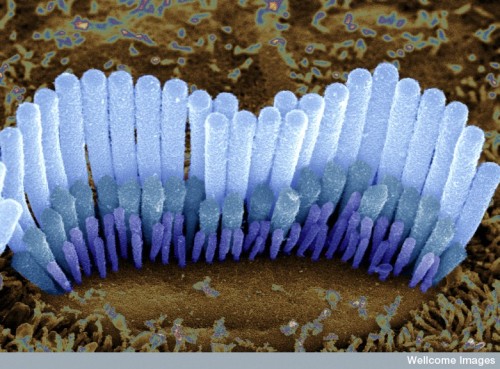
hair cells of a guinea pig's inner ear

17 April 2011

João Cabral de Melo Neto

[from João Cabral de Melo Neto's Selected Poetry, 1937-1990, ed. Djelal Kadir, Wesleyan, 1994]


The Lesson of Poetry

1.

The entire morning spent
like a motionless sun
before the blank page:
beginning of the world, new moon.

You could no longer trace
so much as a line;
neither name nor flower
bloomed in the table's summer,

not even in the paper's midday
brightness, paid for
daily (even though paper
accepts any kind of world).

2.

All night the poet
at his desk, trying
to save from death the monsters
germinated in his inkwell.

Monsters, worms, phantoms
of words – meandering,
urinating on the paper,
smearing it with their carbon.

Carbon from the pencil, carbon
of obsessions, carbon
of extinct emotions, carbon
consumed in dreams.

3.

White struggle on the paper
which the poet resists,
white struggle of blood
flowing from his saltwater veins.

The physics of fear discerned
in daily gestures; fear
of things that never alight and yet
are immobile – unstill still lifes.

And the twenty words collected
in the saltwater of the poet,
to be used by the poet
in his efficient machine.

Always the same twenty words
he knows so well: their operation,
their evaporation, their density
less than the air's.

          – translated by Richard Zenith


Psychology of Composition [excerpt]

V.

I live with certain words,
household bees.

From the clear day
(white parasol)
those lucid spindles
retrieve the filaments of honey
(from the day that unfolded
also like a flower)
that by night
(pit where the aerial
flower goes to rest)
will persist: golden
taste, and sour,
against the sugar of putrefaction.

          – translated by Djelal Kadir

13 April 2011

contemporary Vietnamese poets

[from Black Dog, Black Night: Contemporary Vietnamese Poetry, ed./tr. by Nguyen Do & Paul Hoover, Milkweed, 2008]

Nguyen Do & Paul Hoover

Three Variations at Sixty-Five Years Old [excerpt]
          – Van Cao

I fall into a spiderweb
It wraps me tightly
no way of getting out
I’m like a silkworm
in this life

I want to break the net
but my arms are far too few!

Van Cao


Women Carrying River Water
          – Nguyen Quang Thieu

Long, black, and bony, their toenails splay wide as a hen’s.
For five years, fifteen years – thirsty years and half my life –
I’ve seen them carry water from the river.
Their hair flows down their soft, wet backs,
one hand supporting the thin shoulder poles,
the other clinging to the whiteness of clouds.
The river hides its face in its banks then turns and runs on.
The men leave home silently, carrying fishing poles and dreams of the ocean.
The spiritual fish turn their faces away to weep.
Buoys made of corn sink in the river’s flow.
Angrily and sadly, men are leaving the home
that I have seen for five years, fifteen years – thirsty years and half my life –
following these women who carry river water like naked children
who run along with their mothers and soon grow up.
The girls will always lay poles on their shoulders and go to the shore.
The boys will always leave home silently, carrying fishing poles and ocean dreams.
And the spiritual fish will always turn their faces to weep
in front of the bait, dumbstruck as it gazes from its fishhook.

Nguyen Quang Thieu


Collected Short Poems [excerpt]
          –Tran Dan

A circle of people always surrounds a naked man.

Creation is total force, action, and suddenness including the
          scrotum, which is involved in creation also.

Building a poetry collection is like breaking into a prison.

Tran Dan


To Suddenly Remember
          – Thanh Thao

like someone beating a drum, the rain dropped on my waterproof
          army poncho
which was torn and badly needed mending
my friends were like forest trees, day by day diminishing
the war cut them down
like an electric trimmer
but now they’re all at peace
I remember also that evening, as a child,
the sweetness of the banana in my mother’s hand,
even sweeter when she carried me on her back!
the road over the dike echoed the soul of the river
dark brown sails and bamboo shadows floating slowly
a bridge where an older man got tired
and lay down to rest but not sleep
the room where he keeps only the barest necessities
the ripe smell of bananas
some old chairs
and a small ancient teapot
the aged sunlight
an evening of summer rain
and the bomb’s echoes from the Duong bridge that sounded like
          rolling thunder
my parents lived there in a home
a ten-square-meter country
but because of our greater home
my parents didn’t prevent me
from going into battle
not hoping for a brave death or “rainbow”
I’m the hand on a compass
that only turns toward our room
where everything is old

Thanh Thao

09 April 2011

Dana Levin

[from Dana Levin's Sky Burial, Copper Canyon, 2011]

School of Flesh

         Blush for a cheek of stone.

         Blush for the lips sewn tight with thread, no speech
for the dead
         maker –

         You’ve got the razor. You can make each suture
snap.

         And watch the mouth
bloom up with foam,
         as if he’d drowned himself in soap –

         You lift the neck and let the head drop back.
The mouth yawns wide its prize –

         White thrive.
The larval joy.
         Hot in their gorge on the stew of balms,
a moist exhale –
         as of there were a last breath, a taunt
coiling
         into your inner ear, Good Dog, you dig your hands in,
up-cupping
         the glossal
bed –
         saying, Graduate
of the School of Flesh, Father Conspirator –
         I will

         bite the tongue
from the corpse –


This from That

Aurelian,
              who studies the emergence of butterflies
from chrysalides,
              of fighter jets
from number chars,
              of syllables
from kettledrums –

                            –

              Insects that pupate in a cocoon
must escape from it

              says Wikipedia.

              Wikipedia, which says:
Whilst inside the pupa

              Says: digestive juices, to destroy much
of the larva's body


              larva meaning
its own –

              which has been instructed
to leave a few cells intact for

              holometabolous
total change,
              through the nutrients of suffering, of the self-

              carnivore –
(lumbering up,
              hoisting my flesh from the floor – )

                            –

I study ziggurats
              from cigarettes. Smoke

the effluvium of fire, the
              fire in the mouth from

cigarettes, from
              ziggurat

              striking dry tinder from the tongue –

"It is queer to be assisting
              at the éclosion

                            –

              of a great new mental epoch,"
wrote William James
              in 1906:

eclosion, verb eclose,
              "emergence from concealment" –

which is what "religion and philosophy" do,
              which is what certain

insects do,
              even people, slipping their suits, and what we need

              is a new mental epoch –

whatever lies
              beyond

              self-liquidation –

                            –

Aurelain.
              Who studies

              concerto notes
from finger-scales,
              survivor guilt
from firestorms,
              apologies
from bombing runs –

              Through the open back door,
bending a petunia,

Papilio machaon
              drinking deeply

              and long.


04 April 2011

Staged Right

I like it comes first, I
try to feel shocked. No more a
dependent nor child, the truth is, I'm
an adult with a drink at a bar, my
free will invites me. On me
I hear him say. I feel his
fingers, my bicep squeezed. Next
emotion fresh out of the
limbic Crash goes the glass into the bar
well
swells contentedly, contracts
resentfully, a regular pulse, it
splays his fingers loose, the remaining
pressure only to my shoulder, no capture like
before, he chatters on as caged
parrots do once they yield. Who
ricochets flash through the scrum
are you stools clear on both
sides putting your hands on? Hands rise
his from me first, others toward
him, partway. He & I hold our
ground, focused on the
roughhousing an apron comes, scowl-browed
bartender our expulsion bound. I
spit hard (benny from my
brothers), beer-fed eructation, my
mouth still pursed, shoulder bag to hip,
whiskey cross-eyed, Desolation Valley in my
short-term future. I'm
such a proto-mock Penelope
toe-tapping, sequin-bowtied, no
apocryphal Odysseus back, posturing
danger-scripter, semi-tanked.
Curtseying strangers clear a path, I
zag out blinking, alone so long the
taste of violence rushes me, then no
nothing beyond the gap.
No applause.

Naomi Shihab Nye

[from Naomi Shihab Nye's Honeybee, Harper Collins, 2008]

Running Egret

We want our nature to have a face.
An eye we can look into,
not like ours – clearer. Strong body
moving swiftly over land, belonging to no one.

Nonpartisan egret,
beyond everything that burden us,
unexpected, unpredictable,
sheer motion – flash of white –
creatures with a silence
wider than our own.

There are days we wake and need an egret.


The Little Bun of Hours (excerpt)

Days that felt like sheet cakes in long silver pans
frosted or not, plenty of cake no matter who appeared,
a sift of powdered sugar, and the knife
laid casually by. Maybe a sack of French bread
broken in half. I liked the small stacked plates
on the counter, the way you drove around in a box
without going anywhere. We could send
the bears to school and write notes for them
to take home to their mothers, who were camels
and rabbits. Sometimes I looked at a clock.
When you were four, lightning cracked my brain
and I could see all the way till now, this fist of days
before you leave. It took away my sleep, my confidence,
who were we before you? . . .

31 March 2011

Nathaniel Mackey

[from Nathaniel Mackey's Splay Anthem, New Directions, 2006]

Eye on the Scarecrow

    — “mu” twentieth part —

      The way we lay
  we mimed a body
    of water. It was
this or that way
                         with
        the dead and we
      were them. No
                              one
    worried which . . .
      Millet beer made
our legs go weak,
                             loosed
  our tongues. “The dead,”
                                           we
          said, “are drowning
      of thirst,” gruff
        summons we muttered
    out loud in our
                             sleep . . .
      It was a journey we
  were on, drawn-out
    scrawl we made a road
of, long huthered hajj
                                   we
        were on. Raw strip
      of cloth we now rode,
          wishful, letterless
                                       book
            the ride we thumbed . . .
        Harp-headed ghost whose
          head we plucked incessantly.
    Bartered star.        Tethered
                                                run . . .
      It was a ride we knew we’d
    wish to return to. Every-
        thing was everything.
  nothing no less. No less
                                         newly
      arrived or ancestral, of
        late having to do with
    the name of parts . . .
      Rolling hills rolled
  up like a rug, raw sprawl
                                          of a
        book within a book
      without a name known as
          Namless, not to be
  arrived at again . . .
                                  It was
    the Book of No Avail we
were in did we dare name
  it, momentary kings and
                                          queens,
    fleet kingdon. Land fell
  away on all sides.

                               Past
Lag we caught ourselves,
    run weft at last
  adequate, shadowless,
                                      lit,
      left up Atet Street,
    legs tight, hill after
          hill after hill.
        Had it been a book Book
  of Opening the Book
it
      would have been called,
                                             kept
under lock and key . . .
                                      Hyperbolic
      arrest. Ra was on the
                                        box.
    It was after the end of
  the world . . . To lie on
      our backs looking
    into the dark was all
        there was worth
                                  doing.
  each the aroused eye
one another sought,
    swore he or she
                           saw,
    we lay where love’s
  pharaonic torso lay
      deepest, wide-eyed
                                     all
night without sleep . . .
                                      “String
    our heads with straw,” we
  said, half-skulls tied with
      catgut, strummed . . .
                                         Scratched
    our strummed heads, memory
made us itch. Walked out
  weightless, air what eye
                                         was
      left . . .

                Someone said Rome,
    someone said destroy it.
Atlantis, a third shouted
                                       out . . .
      Low ride among ruins
  notwithstanding we flew.
    Swam, it often seemed,
underwater, oddly immersed,
                                               bodies
          long since bid goodbye,
                                                 we
    lay in wait, remote muses
        kept us afloat. Something
  called pursuit had us by
      the nose. Wafted ether
                                           blown
low, tilted floor, splintered
        feet. Throated bone . . .
    Rickety boat we rode . . .
                                             As
      though what we wanted
  was to be everywhere at
                                          once,
an altered life lived on an
                                         ideal
        coast we’d lay washed up
          on, instancy and elsewhere
                                                      endlessly
      entwined

29 March 2011

Rainer Maria Rilke

[from Rainer Maria Rilke's Duino Elegies, 1923]

Freilich ist es seltsam, die Erde nicht mehr zu bewohnen,
kaum erlernte Gebräuche nicht mehr zu üben,
Rosen, und andern eigens versprechenden Dingen
nicht die Bedeutung menschlicher Zukunft zu geben;
das, was man war in unendlich ängstlichen Händen,
nicht mehr zu sein, und selbst den eigenen Namen
wegzulassen wie ein zerbrochenes Spielzeug.
Seltsam, die Wünsche nicht weiterzuwúnschen. Seltsam,
alles, was sich bezog, so lose im Raume
flattern zu sehen. Und das Totsein ist mühsam
und voller Nachholn, dass man allmählich ein wenig
Ewigkeit spúrt. – Aber Lebendige machen
alle den Fehler, dass sie zu stark unterscheiden.
Engel (sagt man) wüssten oft nicht, ob sie unter
Lebenden gehn oder Toten. Die ewige Strömung
reisst durch beide Bereiche alle Alter
immer mit sich und übertönt sie in beiden.

Schliesslich brauchen sie uns nicht mehr, die Früheentrückten,
man entwöhnt sich des Irdischen sanft, wie man den Brüsten
milde der Mutter entwächst. Aber wir, die so grosse
Geheimnisse brauchen, denen aus Trauer so oft
seliger Fortschritt entspringt – : könnten wir sein ohne sie?
Ist die Sage umsonst, dass einst in der Klage um Linos
wagende erste Musik dürre Erstarrung durchdrang;
dass erst im erschrockenen Raum, dem ein beinah göttlicher Jüngling
plötzlich fúr immer enttrat, das Leere in jene
Schwingung geriet, die uns jetzt hinreisst und tröstet und hilft.

28 March 2011

Vicente Huidobro

[from Vicente Huidobro's Altazor, 1931]

CANTO VII

Al aia aia
ia ia ia aia ui
Tralalí
Lali lalá

Aruaru
           urulario
Lalilá
Rimbibolam lam lam
Uiaya zollonario
                          lalilá

Monlutrella monluztrella
                                       lalolú
Montresol y mandotrina
Ai ai
        Montesur en lasurido

        Montesol
Lusponsedo solinario
Aururaro ulisamento lalilá
Ylarca murllonía
Hormajauma marijauda

Mitradente
Mitrapausa
Mitralonga
Matrisola
               matriola

Olamina olasica lalilá
Isonauta
Olandera uruaro
Ia ia campanuso compasedo

Tralalá
Aí ai mareciente y eternauta
Redontella tallerendo lucenario
Ia ia
Laribamba
Larimbambamplanerella

Laribambamositerella
Leiramombaririlanla
                                lirilam
Ai i a
Temporía

Ai ai aia
Ululayu
            lulayu
                     layu yu
Ululayu

            ulayu
                    ayu yu
Lunatando
Sensorida e infimento
Ululayo ululamento

Plegasuena
Cantasorio ululaciente
Oraneva yu yu yo
Tempovío
Infilero e infinauta zurrosía

Jaurinario ururayú
Montañendo oraranía
Arorasía ululacente
Semperiva
                 ivarisa tarirá

Campanudio lalalí
          Auriciento auronida
Lalalí
         Io ia
iiio

Ai a i a a i i i i o ia

24 March 2011

Vicente Huidobro

[the essay "Creationism" from Vicente Huidobro's Manifestos, original published in 1925; translation by David M. Guss in The Selected Poetry of Vicente Huidobro, New Directions, 1981]

At the end of 1916 I landed in Paris, into the world of the magazine Sic. I barely knew the language, but soon realized that I was dealing with a very futurist scene and one can't forget that just two years before, in my book Pasando y pasando, I had attacked futurism as being too old-fashioned, at the exact moment the whole world was crying out for the birth of something completely new.

I searched everywhere for this created poetry, without relation to the external world, and, when at times I believed I had found it, I soon realized that it was merely my lack of knowledge of the language which had made me see it where it was totally lacking or simply existed in small fragments, as in my earlier books of 1913 and 1915.

Have you noticed the special power, the near-creative sense that pervades the poetry written in a language you are just beginning to utter?

You find fantastic poems which just a year later make you smile.

Gathered around Apollinaire, who was such an undeniable poet, and yet apart from him, one found several earnest searchers; unfortunately, most of them lacked the holy fire, since nothing could be more false than to believe that inspiration is to be found lying in the street. True poetic inspiration is the rarest thing that exists. And I'm not using the word poet here in the intimate sense it holds for me, but rather in its habitual sense, since, for me, there has never been a single poet in the history of the planet.

Today I affirm completely, as I did ten years ago in the Atheneum in Buenos Aires: "There has never been a single poem written in the world, but only some vague essays on how to write one. Poetry is yet to be born on our globe. And its birth will be an event that will revolutionize mankind like the greatest earthquake." I sometimes wonder if it will not go by unnoticed.

Let's make it clear, then, that each time I speak of "poet" I simply use the term to be understood, like stretching a rubberband to encircle those who are nearest the importance which I assign it.

During the period of the magazine Nord-Sud, of which I was one of the founders, we all had more or less the same orientation in our outlooks, but were far enough from another at the core.

While others were making oval skylights, I was making square horizons. As all skylights are oval, poetry continues to be realist. As horizons are not square, the author offers something created by himself.

When Horizon Carré (Square Horizon) came out, here is how I explained the title in a letter to friend an critic Thomas Chazal:

Square horizon. A new fact, invented by me, created by me, which couldn't exist without me. I want, dear friend, to capture in this title the whole of my aesthetics, which you have been aware of for some time now.

This title explains the basis of my poetic theory. Condensed within it is the essence of my principles.

1. To humanize the object. Everything that passes through the body of the poet must be subjected to the greatest possible amount of his heat. Here something as vast and enormous as the horizon is humanized; it becomes intimate, thanks to the adjective SQUARE. The infinite nests in our heart.

2. The indefinite becomes precise. In shutting the windows of our soul, whatever was able to escape, gasify, and unravel, remains enclosed and is solidified.

3. The abstract becomes concrete and the concrete abstract. This means the perfect balance, since if the abstract leaned toward the more abstract, it would dissolve in your hands or filter through your fingers. And if you made the concrete even more concrete, it would help you drink wine or furnish your home, but it would never furnish your soul.

4. Whatever is too poetic to be created is transformed into something created by changing its common value, so that if horizon was poetic in itself, if horizon was poetry in life, by qualifying it with square, it stops being poetry in art. From dead poetry it becomes living poetry.

The few words explaining my concept of poetry on the first page of the book we are speaking of, tells you what I wanted to accomplish in those poems. It said:

To create a poem by taking the elements of life and transforming them to give them a new and independent life of their own.

Nothing descriptive or anecdotal. Emotion must be born from the creative strength alone.

Make a POEM like nature makes a tree.

In the end, it was my exact concept before arriving in Paris: the act of pure creation which you will find, as a true obsession, in every aspect of my work from 1925 on. And this is still my concept of poetry. The poem created in all its parts, as a new object.

I will repeat here the axiom I gave in my talk at the Atheneum in Madrid in 1921, and finally in Paris, in my speech at the Sorbonne, an axiom which sums up my aesthetic principles: "Art is one thing and Nature another. I love Art very much and Nature very much. And if I accept the representations that a man makes from Nature, it proves I love neither Nature or Art."

In two words and to conclude: the creationists are the first poets who have brought to art a poem invented in all parts by the author.

Here, in these pages about creationism, is my poetic testament. I bequeath it to the poets of tomorrow, to those who will be the first of this new species being, the poet, this new species to be born soon; I can feel it. There are signs in the sky.

The near-poets of today are very interesting, but their interests do not interest me.

The wind points my flute toward the future.

01 March 2011

Paul Harding

[from Paul Harding's Tinkers, Bellevue Literary, 2009]

Buy the pendant, sneak it into your hand from the folds of your dress and let the low light of the fire lap at it late at night as you wait for the roof to give out or your will to snap and the ice to be too thick to chop through with the ax as you stand in your husband's boots on the frozen lake at midnight, the dry hack of the blade on ice so tiny under the wheeling and frozen stars, the soundproof lid of heaven, that your husband would never stir from his sleep in the cabin across the ice, would never hear and come running, half-frozen, in only his union suit, to save you from chopping a hole in the ice and sliding into it as if it were a blue vein, sliding down into the black, silty bottom of the lake, where you would see nothing, would perhaps feel only the stir of some somnolent fish in the murk as the plunge of you in your wool dress and the big boots disturbed it from its sluggish winter dreams of ancient seas. Maybe you would not even feel that, as you struggled in clothes that felt like cooling tar, and as you slowed, calmed, even, and opened your eyes and looked for a pulse of silver, an imbrication of scales, and as you closed your eyes again and felt their lids turn to slippery, ichthyic skin, the blood behind them suddenly cold, and as you found yourself not caring, wanting, finally to rest, finally wanting nothing more than the sudden, new, simple hum threading between your eyes. The ice is far too thick to chop through. You will never do it. You could never do it. So buy the gold, warm it with your skin, slip it onto your lap when you are sitting by the fire and all you will otherwise have to look at is your splintery husband gumming chew or the craquelure of your own chapped hands.