[from Taha Muhammad Ali's So What: New & Selected Poems, translated by Peter Cole, Yahya Hijazi, and Gabriel Levin, 1971-2005], Copper Canyon, 2006]
Ambergris
Our traces have all been erased,
our impressions swept away —
and all the remains have been effaced . . .
there isn't a single sign
left to guide us
or show us a thing.
The age has grown old,
the days long,
and I, if not for the lock of your hair,
auburn as the nectar of carob,
and soft as the scent of silk
that was here before,
dozing like Arabian jasmine,
shimmering like the gleam of dawn,
pulsing like a star —
I, if not for that lock of camphor,
would not feel a thing
linking me
to this land.
—
This land is a traitor
and can't be trusted.
This land doesn't remember love.
This land is a whore
holding out a hand to the years,
as it manages a ballroom
on the harbor pier —
it laughs in every language
and bit by bit, with its hip,
feeds all who come to it.
This land denies,
cheats, and betrays us;
its dust can't bear us
and grumbles about us —
resents and detests us.
Its newcomers,
sailors, and usurpers,
uproot the backyard gardens,
burying the trees.
They keep us from looking too long
at the anemone blossom and cyclamen,
and won't allow us to touch the herbs,
the wild artichoke and chicory.
—
Our land makes love to the sailors
and strips naked before the newcomers;
it rests its head along the usurper's thigh,
is disgraced and defiled in its sundry accents;
there seems to be nothing that would bind it to us,
and I — if not for the lock of your hair,
auburn as the nectar of carob,
and soft as the scent of silk,
if not for the camphor,
if not for the musk and the sweet basil,
if not for the ambergris —
I would not know it,
and would not love it,
and would not go near it.
—
Your braid
is the only thing
linking me, like a noose, to this whore.
10.III.1983
20 October 2009


19 October 2009
Charles Olson
[from Charles Olson's The Maximus Poems, University of California, 1983]
"at the boundary of the mighty world" H. (T) 620 foll.
Now Called Gravel Hill -- dogs eat
gravel
Gravelly hill 'father' Pelops otherwise known as
Mud Face founder of
Dogtown. That sort of 'reason': leave things alone.
As it is there isn't a single thing isn't an opportunity
for some 'alert' person, including practically everybody
by the 'greed', that, they are 'alive', therefore. Etc.
That, in fact, there are 'conditions'. Gravelly Hill
or any sort of situation for improvement, when
the Earth was properly regarded as a 'garden
tenement messuage orchard and if this is nostalgia
let you take a breath of April showers
let's us reason how is the dampness in your
nasal passage -- but I have had lunch
in this 'pasture' (B. Ellery to
George Girdler Smith
'gentleman'
1799, for
£ 150)
overlooking
'the town'
sitting there like
the Memphite lord of
all Creation
with my back -- with Dogtown
over the Crown of
gravelly hill
It is not bad
to be pissed off
where there is any
condition imposed, by whomever, no matter how close
any
quid pro quo
get out. Gravelly Hill says
leave me be, I am contingent, the end of the world
is the borders
of my being
I can even tell you
where I run out; and you can find
out. I lie here
so many feet up
from the end of an old creek
which used to run off
the Otter ponds. There is a bridge
of old heavy slab stones
still crossing the creek on
the 'Back Road' about three rods
from where I do end northerly, and from my Crown
you may observe, in fact Jeremiah Millett's
generous pasture
which, in fact, in the first 'house'
(of Dogtown) is a part of the slide of
my back, to the East: it isn't so decisive
how one thing does end
and another begin to be very obviously dull about it
I should like to take the time to be dull
there is obviously much to be done and the fire department
rushed up here one day -- they called it
Bull Field in the newspaper -- when just that
side of me I am talking about,
which belonged to Jeremiah Millett
and rises up rather sharply
-- it became Mr Pulsifer's and then,
1799, the property of the town
of Gloucester -- was burned off.
My point is, the end of myself,
happens, on the east side (Erechthonios)
to be the beginning of another set
of circumstance. The road,
which has gone aroundme, swings
just beyond where Jeremiah Millett had his house
and there's a big rock about ends my being,
properly, swings
to the northeast, and makes its way
generally staying northeast in direction
to Dogtown's Square or the rear of
William Smallman's
house where rocks pile up
darkness, in a cleft in the earth
made of a perfect pavement
Dogtown Square
of rocks alone March, the holy month
(the holy month,
LXIII
of nothing but black granite turned
every piece,
downward, to darkness,
to chill and darkness. From which the height above it even
in such a fearful congery
with a dominant rock like a small mountain
above the Hellmouth the back of Smallmans is
that this source and end of the way from the town into
the woods is only -- as I am the beginning, and Gaia's
child -- katavothra. Here you enter
darkness. Far away from me, to the northeast,
and higher than I, you enter
the Mount,
which looks merry,
and you go up into it
feels the very same as the corner
where the rocks all are
even smoking a cigarette on the mount
nothing around you, not even the sky
relieves the pressure of this declivity
which is so rich and packed.
It is Hell's mouth
where Dogtown ends
(on the lower
of two roads into
the woods.
I am the beginning
on this side
nearest the town
and it -- this paved hole in the earth
is the end (boundary
Disappear.
17 October 2009
Paul Guest
[from Paul Guest's Notes for My Body Double, University of Nebraska, 2007]
At Last
All day I wanted, I ached, to tell
you of the rabbit dead in the road
and how the whole day I marked
time with its evisceration —
if at first I had touched its flank
or its sleek ears tucked back,
I would have taken the last measure
of its warmth. The ghost
of its abortive bound would be near.
And later when its torso
began to show, when its pelt was peeled
and its innards unspooled,
I didn't grieve. Flies had come
and in their noise, in their work,
they glittered. The flesh
seemed to sink with the sun
and I thought to tell you
that night at the door,
taking whatever you held
into my arms, at last I've kept
vigil over something,
over ruin, come see, come see, come see.
In the cuff of the wind
white petals sloughed
from the branches of the gnarled dogwood,
the tree I was taught
Christ's cross was cut from.
If once I believed
in so much holy ruin,
there was none to be found there.
And this was right.
In the matted entrails
of the slaughtered,
whoever thought to know the future
in the slick, wet coils
never saw me keeping watch
in the failing light
for the dead to vanish and you to appear.
11 October 2009
H. D.
[from H. D.'s Collected Poems, 1912-1944, New Directions, 1986]
Hermes of the Ways
The hard sand breaks,
and the grains of it
are clear as wine.
Far off over the leagues of it,
the wind,
playing on the wide shore,
piles little ridges,
and the great waves
break over it.
But more than the many-foamed ways
of the sea,
I know him
of the triple path-ways,
Hermes,
who awaits.
Dubious,
facing three ways,
welcoming wayfarers,
he whom the sea-orchard
shelters from the west,
from the east
weathers sea-wind;
fronts the great dunes.
Wind rushes
over the dunes,
and the coarse, salt-crusted grass
answers.
Heu,
it whips round my ankles!
II
Small is
this white stream,
flowing below ground
from the poplar-shaded hill,
but the water is sweet.
Apples on the small trees
are hard,
too small,
too late ripened
by a desperate sun
that struggles through sea-mist.
The boughs of the trees
are twisted
by many bafflings;
twisted are
the small-leafed boughs.
But the shadow of them
is not the shadow of the mast head
nor of the torn sails.
Hermes, Hermes,
the great sea foamed,
gnashed its teeth about me;
but you have waited,
where sea-grass tangles with
shore-grass.
10 October 2009
Robert Bly
[from Robert Bly's My Sentence Was a Thousand Years of Joy, Harper Collins, 2005]
Hiding in a Drop of Water
It is early morning, and death has forgotten us for
A while. Darkness owns the house, but I am alive.
I am ready to praise all the great musicians.
Whatever happens to me will also happen to you.
Surely you must have realized this from hearing
The way the strings cry out no matter who hits them.
From the great oak trees in the yard in October,
Leaves fall for hours each day. Every night
A thousand wrinkled faces look up at the stars.
Still we know that at any second the soul can stand
Up and start across the desert, as when Rabia ended up
Riding on a resurrected donkey toward the Meeting.
It is this reaching toward the Kaaba that keeps us glad.
It is this way of hiding inside a drop of water
That lets the hidden face become visible to everyone.
Gautama said that when the Great Ferris Wheel
Stops turning, you will still be way up
There, swinging in your seat and laughing.
09 October 2009
Eknath Easwaran
[from Eknath Easwaran's The Bhagavad Gita for Daily Living, Volume 3: To Love Is to Know Me, Nilgiri, 1988]
Living in separateness means being dominated by private urges, trying to have our own way and do only what we like, unable to see what cries out to be done for the welfare of the world around us. When this darkness becomes deep enough, we can't see which direction to go; we will always be losing our way, never coming out at all. When we decide to say no to private, personal urges, we start to enter a world of light where the path is clear. We know where we are going, and we can travel safely and surely.
Living in separateness means being dominated by private urges, trying to have our own way and do only what we like, unable to see what cries out to be done for the welfare of the world around us. When this darkness becomes deep enough, we can't see which direction to go; we will always be losing our way, never coming out at all. When we decide to say no to private, personal urges, we start to enter a world of light where the path is clear. We know where we are going, and we can travel safely and surely.
03 October 2009
Barbara Guest
[from Barbara Guest's Collected Poems, ed. Hadley Haden Guest, Wesleyan, 2008]
Cape Canaveral
Fixed in my new wig
the green grass side
hanging down
I impart to my silences
operas.
Climate cannot impair
neither the gray clouds nor the black waters
the change in my hair.
Covered with straw or alabaster
I'm inured against weather.
The vixen's glare, the tear on the flesh
covered continent where the snake
withers happily and the nude deer
antler glitters, neither shares
my rifled ocean growth
polar and spare.
Eyes open
spinning pockets
for the glass harpoons
lying under my lids
icy as summers
Nose ridges
where the glaciers melt
into my autumnal winter-fed cheek
hiding its shudder in this kelp
glued
cracked as the air.
01 October 2009
Jed Rasula
[from Jed Rasula's The American Poetry Wax Museum, National Council of Teachers of English, 1996]
the attenuated lyric personalism that is the dominant workshop mode has constricted the range of expression and blotted out the diversity of ethnopoetic traditions. John Koethe's analysis is astute: "Writing programs are not usually 'schools,'" he points out. But, "[i]n the absence of explicitly articulated theoretical principles regarding the nature and purpose of poetry, they inculcate, by default, a poetics of the 'individual voice' that valorizes authenticity and fidelity to its origins in prepoetic experience or emotion." In other words, ethnic diversity at the applicant and trainee level does not automatically translate into poetic diversity. So the writing programs have become a safe haven, a refuge from the sociocultural perplexities signified by "theory" and "postmodernism" (not to mention "late capitalism"), promoting a return to the now paradoxically reassuring anxieties of self-doubt.
the attenuated lyric personalism that is the dominant workshop mode has constricted the range of expression and blotted out the diversity of ethnopoetic traditions. John Koethe's analysis is astute: "Writing programs are not usually 'schools,'" he points out. But, "[i]n the absence of explicitly articulated theoretical principles regarding the nature and purpose of poetry, they inculcate, by default, a poetics of the 'individual voice' that valorizes authenticity and fidelity to its origins in prepoetic experience or emotion." In other words, ethnic diversity at the applicant and trainee level does not automatically translate into poetic diversity. So the writing programs have become a safe haven, a refuge from the sociocultural perplexities signified by "theory" and "postmodernism" (not to mention "late capitalism"), promoting a return to the now paradoxically reassuring anxieties of self-doubt.
Lucia Perillo
[from Lucia Perillo's Inseminating the Elephant, Copper Canyon, 2009]
Snowstorm with Inmates and Dogs
The prison kennel's tin roof howls
while the dogs romp outside through the flakes.
The inmates trained a dog to lift my legs --
for months they rolled the concrete floor
in wheelchairs, simulating.
Through a window I watch them cartwheel now,
gray sweatpants rising against the whitened hill
traversed by wire asterisks and coils.
At first I feared they pitied me,
the way I flinched at the building's smell.
Now the tin roof howls, the lights go off
to the sound of locking doors. Go on, breathe --
no way the machinery of my lungs
is going to plow the county road.
Didn't I try to run over a guy,
spurned love being the kindling stick that rubbed
against his IOUs? Easy to land here,
anyone could -- though I think laughter
would elude me, no matter what the weather.
Compared to calculating how far to the road.
Signs there say: CORRECTIONS CENTER DO NOT PICK UP HITCHHIKERS.
My instructions were: Accept no notes or photographs,
and restrict the conversation to such topics as
how to teach the dog to nudge
the light switch with his nose.
Now the women let their snowballs fly -- as if
the past were a simple matter that could splat and melt.
Only my red dog turns his head
toward the pines beyond the final fence
before the generator chugs to life.
poets who have won the MacArthur
[my thanks to Emily Lloyd for this list]
Despite my raging joy that Heather McHugh has won half a million dollars, I deplore prize giving of all kinds because of the implied value judgments, politics, social bias, cultural pressure, category exclusions, etc.
Below is a chronological list of poets who have won the MacArthur.
How many of these poets have you heard of? How many have you read? How many have taught you things you value? What do your answers say about your position in or out of the poetry mainstream? What poets are not on the list who would be on your list? What is your response to the enthronement of poets (or anyone) in this fashion?
I highly recommend Jed Rasula's The American Poetry Wax Museum for a fascinating contrarian view of the poetry policy makers of the 20th century.
Poets who have won the MacArthur:
A.R. Ammons
Joseph Brodsky
Derek Walcott
Robert Penn Warren
Brad Leithauser
A.K. Ramanujan
Robert Hass
Charles Simic
Galway Kinnell
John Ashbery
Daryl Hine
Jay Wright
Douglas Crase
Richard Kenney
Mark Strand
May Swenson
Allen Grossman
Jorie Graham
John Hollander
Alice Fulton
Eleanor Wilner
Amy Clampitt
Irving Feldman
Thom Gunn
Ann Lauterbach
Jim Powell
Adrienne Rich
Sandra Cisneros
Richard Howard
Thylias Moss
Susan Stewart
Linda Bierds
Edward Hirsch
Ishmael Reed
Campbell McGrath
Anne Carson
Lucia Perillo
C.D. Wright
Peter Cole
Heather McHugh
30 September 2009
Karen Volkman
[from Karen Volkman's Crash's Law, Norton, 1996]
Persephone at Home
No good reflecting on what might have been
if I'd been different -- no straying
after foreign flowers, no hunger
for bitter fruit. In the beginning --
such a child -- I thought it punishment,
not fate. It is daylight I miss
mainly. What we are granted of sun here
is a dim relentless red. I wander
the reeking river, I pat
fat Cerberus on his many manic heads.
The moldy skiff makes its incessant
prompt arrivals, so efficient,
our dutiful Charon growling orders
from the prow. Huge-eyed, uncomprehending,
the new recruits stare round. Wives still
clutching their washing, wailing children,
soldiers blood-stained and battered
from the latest engagement.
Then that blessed briny sip, welcome
oblivion -- they're blank as babies.
All nights the shrieks of the tortured serenade
our marriage bed. Once it lulled
me rigid. For years after that
first celebrated rape,
I lay cold beneath his coldness,
stiff in his stiff embrace.
I'll give no prince to this kingdom.
That thing is dead.
For years, he broke me for it.
For years, I bled and bled.
That was then. Queen
of his blasphemous backwater,
I make my claim. On earth,
I am virginal abundance, fat and full.
Here, bony and empty, I straddle
my killer, my captor, my grief, my bane,
and tear and take
the torn lip, the raked neck, the aching thighs,
that will remind me
through the long black morning
I am alive.
White Lily
Gnomish in its rounded hunch
of greeny folds, three-fourths of the year
it resembles a weed. Now spring's
unseasonable heat
brings vindication. Trumpet
over frilled, frail trumpet
spills its bone-white notes
in April air. Below, in shadow --
shrunken, overawed -- skulks
the novice rosebush
we rooted in the fall. This
spendthrift, who's squandered
brilliant buds for months,
today knows the earthy weight
of morning-after. Our double
hibiscus, also, pinkly plumed,
succumbed to a plumber's truck
that veered too soon. But the lily
in her straight ascetic's
rigid pose, white as the ember
of a low, enduring fire
takes her pleasure like
the wife of the pastor
come to bed -- prim in her cotton frock
throughout the day, precise
in her firm instructions
to the maid, who cradled
in the rough caress of muslin sheets
bares her stoic shoulders to the room
and seizes in her strong white legs
the truant moon.
29 September 2009
Anne Waldman
[from Anne Waldman's Manatee/Humanity, Penguin Books, 2009]
& in the dream it was wolves all the way down,
wolf pack thrashing & gnawing at the corpses of other animals
cannibal heaven
misunderstood
a small splash, a chill
an eye caught
trapped!
stare!
quick!
shift!
metallic shimmer
cloaks & hoods of the imposters
rent apart by wolves
"I am a youth with golden cymbals dancing"
then one, turns
to me as in blame
would you come to my rescue?
reliable humans? would you?
notice animals dressed as humans now, imposter humans
strewn out on the charnel ground, clothed
battered & trying to be animal again, scratch wolf-eyes off the facade of human
images of many ravage sites flash by
as if there is atavistic memory
creation of a perceptual world of death & destruction
long evolutionary gestation of death & destruction
we stopped to observe (my companion always with me now);
cougar, head snapped
entrails ripped out . . . & spread all around
those parts not eaten
cougar cups eviscerated, killer instinct or survival
what can we learn from the predatory nature of other animals
to surround the bison
down the cattle
the other way around, you said
we came first
so like them . . .
we in our sweet-smelling realm so like them--
pack of wolves
& all breaths escape to exhale in the continued plight of
wolves, loyal in their pack abode, cunning
bright-eyed ones
wolfskin!
ride over me tonight
& manatee
you can't mix a human monster ever enough to aid the manatee
surely our conscious plans have precursors in animal brains
28 September 2009
Charles Olson
Proprioception
Physiology: the surface (senses—the 'skin': of 'Human
Universe') the body itself—proper—one's own
'corpus': PROPRIOCEPTION the cavity of the body,
in which the organs are slung: the viscera, or
interoceptive, the old 'psychology' of feeling,
the heart; of desire, the liver; of sympathy, the
'bowels'; of courage—the kidney etc—gall,
(Stasis—or as in Chaucer only, spoofed)
Today: movement, at any cost. Kinesthesia: beat (nik)
the sense whose end organs lie in the muscles,
tendons, joints, and are stimulated by bodily
tensions (—or relaxations of same). Violence:
knives/anything, to get the body in.
To which
PROPRIOCEPTION: the data of depth sensibility/the 'body' of us as
object which spontaneously or of its own order
produces experience of, 'depth' Viz
SENSIBILITY WITHIN THE ORGANISM
BY MOVEMENT OF ITS OWN TISSUES
'Psychology': the surface: consciousness as ego and thus no flow
because the 'senses' of same are all that sd contact
area is valuable for, to report in to central. In-
THE WORKING spection, followed hard on heels by, judgment
'OUT' OF (judicium, dotha: cry, if you must/all feeling may
'PROJECTION' flow, is all which can count, at sd point. Direction
outward is sorrow, or joy. Or participation: active
social life, like, for no other reason than that—
social life, in the present. Wash the ego out, in its
own 'bath' (os)
The 'cavity'/cave: probably the 'Unconscious'? That
is, the interior empty place filled with 'organs'? for
'functions'?
The advantage is to 'place' the thing, instead of
it wallowing around sort of outside, in the
THE 'PLACE' universe, like, when the experience of it is intero-
OF THE ceptive: it is inside us/& at the same time does
'UNCONSCIOUS' not feel literally identical with our own physical or
mortal self (the part that can die). In this sense
likewise the heart, etc, the small intestine etc, are
or can be felt as—and literally they can be—
transferred. Or substituted for. Etc. The organs.—
Probably also why the old psychology was chiefly
visceral; neither dream, nor the unconscious, was
then known as such. Or allowably inside, like.
'ACTION'—OR, AGAIN, 'MOVEMENT'
This 'demonstration' then leads to the same third,
or corpus, thing or 'place,' the
proprious-ception
'one's own'-ception
the 'body' itself as, by movement of its own tis-
sues, giving the data of, depth. Here, then, wld be
the soul is what is left out? Or what is psysiologically even
proprioceptive the 'hard' (solid, palpable), that one's life is
informed from and by one's owl literal body—
as well, that is, as the whole inner mechanism,
which keeps us so damn busy (like eating, sleeping,
urinating, dying there, by deterioration of sd
'functions' of sd 'organs')—that this mid-thing
between, which is what gets 'buried,' like, the
flesh? bones, muscles, ligaments, etc., what one
uses, literally, to get about etc
that this is 'central,' that is—in
this 1/2 of the picture—what they call the SOUL,
the intermediary, the intervening thing, the inter-
ruptor, the resistor. The self.
The gain: to have a third term, so that movement or action
is 'home.' Neither the Unconscious nor Projection
(here used to remove the false opposition of
'Conscious'; 'consciousness' is self) have a home
unless the DEPTH implicit in physical being—
built-in space-time specifics, and moving (by
movement of 'its own') —is asserted, or found-
out as such. Thus the advantage of the value
'proprioception.' As such.
The 'soul' then is equally 'physical.' Is the self.
its own Is such, 'corpus.' Or—to levy the gain psychology
perception from 1900, or 1885, did supply until it didn't
(date? 1948?)—the three terms wld be:
surface (senses) projection
cavity (organs—here read 'archtypes')
unconscious the body itself—consciousness:
implicit accuracy, from its own energy as a state of
implicit motion.
identity, therefore (the universe is one) is supplied; and the
abstract-primitive character of the real (asserted)
is 'placed': projection is discrimination (of the
object from the subject) and the unconscious is the
universe flowing-in, inside.
25 September 2009
David St. John
[from David St. John's Study for the World's Body: New and Selected Poems, 1994, Harper Collins]
Slow Dance
It's like the riddle Tolstoy
Put to his son, pacing off the long fields
Deepening in ice. Or the little song
Of Anna's heels, knocking
Through the cold ballroom. It's the relief
A rain enters in a diary, left open under the sky.
The night releases
Its stars, & the birds the new morning. It is an act of grace
& disgust. A gesture of light:
The lamp turned low in the window, the harvest
Fire across the far warp of the land. The somber
Cadence of boots returns. A village
Pocked with soldiers, the dishes rattling in the cupboard
As an old serving woman carries a huge, silver spoon
Into the room & as she polishes she holds it just
So in the light, & the fat
Of her jowls
Goes taut in the reflection. It's what shapes
The sag of those cheeks, & has
Nothing to do with death though it is as simple, & insistent.
Like a coat too tight at the shoulders, or a bedroom
Weary of its single guest. At last, a body
Is spent by sleep: A dream stealing the arms, the legs.
A lover who has left you
Walking constantly away, beyond that stand
Of bare, autumnal trees: Vague & loose. Yet, it's only
The dirt that consoles the root. You must begin
Again to move, towards the icy sill. A small
Girl behind a hedge of snow
Working a stick puppet so furiously the passersby bump
Into one another, watching the stiff arms
Fling out to either side, & the nervous goose-step, the dances
Going on, & on
Though the girl is growing cold in her thin coat & silver
Leotard. She lays her cheek to the frozen bank
& lets the puppet sprawl upon her,
Across her face, & a single man is left twirling very
Slowly, until the street
Is empty of everything but snow. The snow
Falling, & the puppet. That girl. You close the window,
& for the night's affair slip on the gloves
Sewn of the delicate
Hides of mice. They are like the redemption
Of a drastic weather: Your boat
Put out too soon to sea,
Come back. Like the last testimony, & trace of desire. Or,
How your blouse considers your breasts,
How your lips preface your tongue, & how a man
Assigns a silence to his words. We know lovers who quarrel
At a party stay in the cool trajectory
Of the other's glance,
Spinning through pockets of conversation, sliding in & out
Of the little gaps between us all until they brush or stand at last
Back to back, & the one hooks
An ankle around the other's foot. Even the woman
Undressing to music on a stage & the man going home the longest
Way after a night of drinking remember
The brave lyric of a heel-&-toe. As we remember the young
Acolyte tipping
The flame to the farthest candle & turning
To the congregation, twirling his gold & white satin
Skirts so that everyone can see his woolen socks & rough shoes
Thick as the hunter's boots that disappear & rise
Again in the tall rice
Of the marsh. The dogs, the heavy musk of duck. How the leaves
Introduce us to the tree. How the tree signals
The season, & we begin
Once more to move: Place to place. Hand
To smoother & more lovely hand. A slow dance. To get along
You toss your corsage onto the waters turning
Under the fountain, & walk back
To the haze of men & women, the lazy amber & pink lanterns
Where you will wait for nothing more than the slight gesture
Of a hand, asking
For this slow dance, & another thick & breathless night.
Yet, you want none of it. Only, to return
To the countryside. The fields & long grasses:
The scent of your son's hair, & his face
Against your side,
As the cattle knock against the walls of the barn
Like the awkward dancers in this room
You must leave, knowing the leaving as the casual
& careful betrayal of what comes
Too easily, but not without its cost, like an old white
Wine out of its bottle, or the pages
Sliding from a worn hymnal. At home, you walk
With your son under your arm, asking of his day, & how
It went, & he begins the story
How he balanced on the sheer hem of a rock, to pick that shock
Of aster nodding in the vase, in the hall. You pull him closer
& turn your back to any other life. You want
Only the peace of walking in the first light of morning,
As the petals of ice bunch one
Upon another at the lip of the iron pump & soon a whole blossom
Hangs above the trough, a crowd of children teasing it
With sticks until the pale neck snaps, & flakes spray everyone,
& everyone simply dances away.
Leap of Faith
No less fabulous than the carved marble inner
Ear of a lost Michelangelo & more
Blinding than the multiple courts & interior facets
Of a black diamond held up in broken moonlight
This final geography acknowledges its trunks of
Ebony & its boughs of summer rain
Though there at the gate where Dante burned his
Initials into the face of the oak shield
I hesitated before following the switchback trail up
To the precipice overlooking the canyon the abyss
So relished by philosophy & when I saw you
On the opposite cliff in your long cape & gold
Shoes with frayed thin ribbons snaking up your ankles
Like anyone approaching from the foot of a bridge
I simply stepped toward you & below the bones
Of the fallen shone in the lightning & the prayers
& certainly it was there in that country
Braced between twin brackets of stone I saw only one
Belief remains for a man whose life is spared by
A faith more insupportable than air
24 September 2009

21 September 2009
Jed Rasula
[from Jed Rasula's The American Poetry Wax Museum, National Council of Teachers of English, 1996]
The dominant modern institutions, according to Michel de Certeau in The Practice of Everyday Life, are colonization, psychiatry, and pedagogy, which focus and bring into line the renegade tendencies of the masses, the unconscious, and the child, respectively. The society of the spectacle engineers these elements into a coherent ideological motif, that of the nation, which is therefore less a polity than a fantasy. The fantasy is certified in its purity as a hegemonic "voice" at that point when individual members of the society or group appear to spontaneously exhibit the rules of order, the principles of cohesion, and reiterate in almost ritual fashion a miraculous unity of individual utterance and collective sentiment. This is the birth of the poetry workshop.
The dominant modern institutions, according to Michel de Certeau in The Practice of Everyday Life, are colonization, psychiatry, and pedagogy, which focus and bring into line the renegade tendencies of the masses, the unconscious, and the child, respectively. The society of the spectacle engineers these elements into a coherent ideological motif, that of the nation, which is therefore less a polity than a fantasy. The fantasy is certified in its purity as a hegemonic "voice" at that point when individual members of the society or group appear to spontaneously exhibit the rules of order, the principles of cohesion, and reiterate in almost ritual fashion a miraculous unity of individual utterance and collective sentiment. This is the birth of the poetry workshop.
20 September 2009
Sixty Some

Today Apobiz Press published my new book, Sixty Some.
Read it in your browser or buy a copy for your favorite ebook device.
17 September 2009
Rae Armantrout
[from Rae Armantrout's Up to Speed, Wesleyan, 2004]
Entanglement
1
"Don't let the car fool you.
My treasure
is in heaven."
2
The material world is made up
entirely
of collisions
between otherwise
indefinite objects.
Then what is a collision?
(Or the physical world
collapses
into place
at the shock of
being seen.)
3
In the shorter version,
tentacled
stomach swallows stomach.
In a long dream,
I'm with Aaron,
visiting his future,
helping him make choices.
16 September 2009
Robert Bly
[Robert Bly in Five Points 10, 2006]
Something About Morning Pajamas
When you've been sleeping all night in a warm bed
There's sometimes a playful odor in your pajamas
It's a bit lowlife, but satisfying
It is some sort of fragrant warmth
That your balls created during the night.
It's a mammal delight related
To the way the calf
Loves the cow's udder.
That mammal delight is one of the nouns
Of this earth.
Don't be ashamed, friends.
Don't throw the pajamas in the washer.
Don't open the window;
Forget the Pilgrims.
Think how sweet it is
That advice should come
From a source so deep.
15 September 2009
Monique Wittig
[from Monique Wittig's Les Guérillères, translated by David Le Vay, Beacon, 1969]
As regards the feminaries the women say for instance that they have forgotten the meaning of one of their ritual jokes. It has to do with the phrase, The bird of Venus takes flight towards evening. It is written that the lips of the vulva have been compared to the wings of a bird, hence the name of bird of Venus that has been given them. The vulva has been compared to all kinds of birds, for instance to doves, starlings, bengalis, nightingales, finches, swallows. They say that they have unearthed an old text in which the author, comparing vulvas to swallows, says that he does not know which of them moves better or has the faster wing. However, The bird of Venus takes flight towards evening, they say they do not know what this means.
The golden fleece is one of the designations that have been given to the hairs that cover the pubis. As for the quests for the golden fleece to which certain ancient myths allude, the women say they know little of these. They say that the horseshoe which is a representation of the vulva has long been considered a lucky charm. They say that the most ancient figures depicting the vulva resemble horseshoes. They say that in fact it is in such a shape that they are represented on the walls of palaeolithic grottos.
The women say that the feminaries give pride of place to the symbols of the circle, the circumference, the ring, the O, the zero, the sphere. They say that this series of symbols has provided them with a guideline to decipher a collection of legends they have found in the library and which they have called the cycle of the Grail. These are to do with the quests to recover the Grail undertaken by a number of personages. They say it is impossible to mistake the symbolism of the Round Table that dominated their meetings. They say that, at the period when the texts were compiled, the quests for the Grail were singular unique attempts to describe the zero the circle the ring the spherical cup containing the blood. They say that, to judge by what they know about their subsequent history, the quests for the Grail were not successful, that they remained of the nature of a legend.
There are also legends in which young women having stolen fire carry it in their vulvas. There is the story of her who fell asleep for a hundred years from having wounded her finger with her spindle, the spindle being cited as the symbol of the clitoris. In connection with this story the women make many jokes about the awkwardness of the one who lacked the priceless guidance of a feminary. They say laughing that she must have been the freak spoken of elsewhere, she who, in place of a little pleasure-greedy tongue, had a poisonous sting. They say they do not understand why she was called the sleeping beauty.
13 September 2009
Pamela Alexander
[from Pamela Alexander's Navigable Waterways, Yale, 1985]
The Garden in the Middle
Panes and eggs make fragile dozens:
two times six in cardboard nests, food
for angels who eat cake; three
times four the membranes between weathers.
Frames hold themselves in wooden hugs
that keep the world together, the glass
a cubist with twelve angles on what is:
peach tree; sea flexing; perhaps a house
being painted blue. Here, a Q:
a british line. A dozen people
wait to buy beer in the sculpture garden.
English sparrows and leaves also
stand in lines together, higher
than the humans. Big plants
digest sunlight and rumble in their juices.
People through the queue sit
to tea-cakes and quiches
at tables made of metal imitating
lace: ornate with curlicues,
the iron legs are painted white
as eggs. Dozens of dozens of windows
surround the lines of this and that:
the museum looks out, and in,
at its informal center. The courtyard
a disordered game board:
tables white squares, flagstones grey, both
scattered crazily. Couples
play hearts everywhere. Queens and
pawns and wandering knights take cues.
Jokers coin jingles
and wink. Second fiddles
fiddle with their drinks. And hundreds
of visions of the light touching things
pass through the tiny panes of eyes each
instant.
Hands hold the light up
as they gesture, conducting
conversations. When
the people in the garden talk, they are
what they say. When they are quiet
their bodies are maps of the cosmos,
hands five-pointed stars. Fish dive in the blue
streaks of their arms, angels rise
in their smiles.
Rings and bracelets flash like waves
landing, waves fragile
as glass, as white shells washed ashore.
Lynne Thompson
[from Lynne Thompson's Beg No Pardon, Perugia Press, 2007]
A Sorceress Strolls New Grass
I am neither mother nor turquoise neckwear
but you are such young women,
such new potatoes, and there is much
for me to tell you:
that bishops joyride in the dead of night,
that blue's favorite color is blue
and earth is just a gaudy paragraph.
And though I am ripe as November, I can tell you
no sorceress ever abandons midday
and a sculptor is always better
in a waterbed.
Of course, I'm vainglorious with my knowing and croaking --
but you women are writing your own Book of Migration
and without warning, I feel useless as an empty valise.
What you know makes the bandicoot fly and you converse
in flamingo and seashell, smell like smoke and rapscallions.
You are tambourines
in the stewing pot,
a crucible of cymbals.
Being fresh as new grass, you
inspire me to astonish, then gloat;
to beg no pardon, then begin.
12 September 2009
Tom C. Hunley
[from Tom C. Hunley's Octopus, Logan House, 2008]
Niagara Falls Honeymoon
In this setting, how could there be a conflict?
The water keeps breaking on the rocks, like an
an endless stream of promises. She is just
out of college. He is just out of rehab. Man
versus nature, man versus self, man versus woman.
Tonight will be her first time. It will be his first time.
He doesn't have a quarter ounce of pot
stashed in his suitcase. She isn't pregnant. I am
an unreliable narrator, but you can believe me: there
will be a climax, plenty of dialogue, a plot twist that
looks tiny at first, though it changes
everything, and keeps growing. There will be
a resolution, and much later, an ending. For now,
he sits on a rock, she sits on his lap, and his
eyes try hard to hold all this new beauty
as water falls down the crags of her cheeks.
08 September 2009
Mary Jones
[new poems from Mary Jones, my dearly-beloved 92-year-old aunt]
Tommy
There’s Tommy with Rascal
and Nicky and Sam
out there on the ice,
but that’s not where I am.
Not there on the ice
in Medway, not now
though that would be nice
but saddening somehow.
I came here to Chelmsford
to live out my years
— reminiscing with photos
happiness, tears.
Looking at photos
sorting papers and stuff
brings back many memories
but that’s not enough.
Lily
There’s Lily on the river
paddling the canoe
all by herself
as often she would do.
Our long green canoe
how many it has carried
all my brothers and my sisters
even more, when they were married.
And out there on the river
out there on the brook
up to the old swimming hole
or down to the dam, to look,
out there on the river
in the long green canoe
over the sky in the river
there she is, just passing through.
01 September 2009
Edmund Wilson
[from Edmund Wilson's Axel's Castle, Scribner's, 1932]
The real elements, of course, of any work of fiction, are the elements of the author's personality: his [sic] imagination embodies in the images of characters, situations and scenes the fundamental conflicts of his nature or the cycle of phases through which it habitually passes. His personages are personifications of the author's various impulses and emotions: and the relations between them in his stories are really the relations between these. One of the causes, in fact, of our feeling that certain works are more satisfactory than others is to be found in the superior thoroughness and candor with which the author has represented these relations. We feel his world to be real and complete, not merely in proportion to the variety of elements it includes, but also in proportion as we recognize these elements as making up an organic whole. From this point of view, Dostoevsky is one of the most satisfactory of novelists; Myshkin and Rogozhin thrill us because they are the opposite poles of one nature; the three brothers Karamazov move us because they are the spirit, mind and body of one man. And if we ask ourselves why even so great a novelist as Dickens does not make upon us so profound an impression as Dostoevsky, we realize that it is because in the case of Dickens, wide and varied as the world of his novels is, the novelist himself is not sufficiently conscious of the significance of what happens there, so that, except in the very best of them, he has admitted a larger conventional element than the greatest novelists ordinarily allow and has been content ot press into service melodramatic "good" characters and villains into whom he has scarcely projected himself at all. . . .
Joyce has found for this new vision a new language, but a language which, instead of diluting or doing violence to his poetic genius, enables it to assimilate more completely and successfully than that of perhaps any other poet of our age to the new self-consciousness of the modern world. But in achieving this, Joyce has ceased to write verse. I have suggested, in connection with Valery and Eliot, that verse itself as a literary medium is coming to be used for fewer and fewer and for more and more special purposes, and that it may be destined to fall into disuse.
27 August 2009
Rae Armantrout
[from Rae Armantrout's Versed, Wesleyan, 2009]
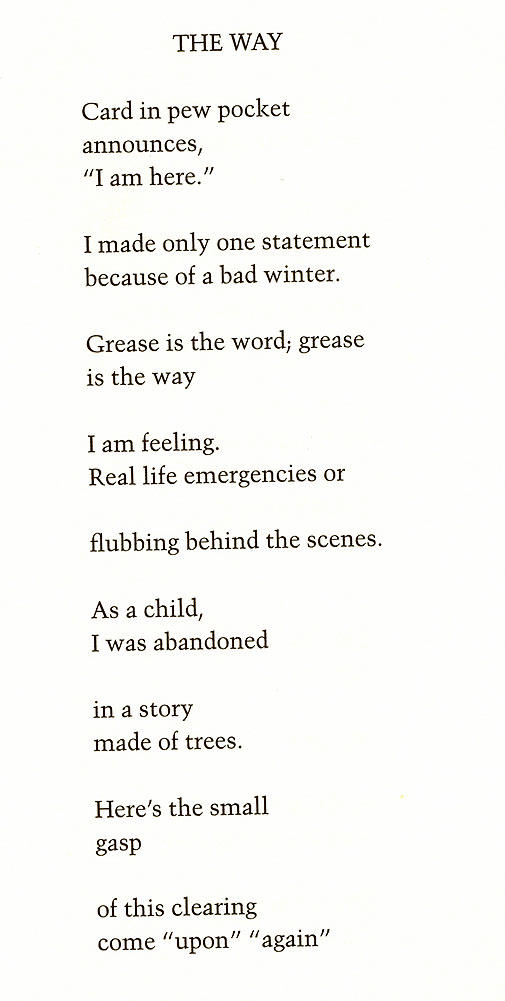
Solution
A solution is found
when creatures
from the last ice age
band together
to survive.
Circumstances spin
like the mobile
above a baby crib.
Follow along
with an endearing
first person,
a penguin.
You won't get far.
You're the thing
that waits
to trap
each passing thought,
the anxious
blank
that God loves.
Solution
A solution is found
when creatures
from the last ice age
band together
to survive.
Circumstances spin
like the mobile
above a baby crib.
Follow along
with an endearing
first person,
a penguin.
You won't get far.
You're the thing
that waits
to trap
each passing thought,
the anxious
blank
that God loves.
22 August 2009
Jack Spicer
[from Jack Spicer's My Vocabulary Did This to Me: Collected Poems, Wesleyan, 2008]
For Harvey
When you break a line nothing
Becomes better.
There is no new (unless you are humming
Old Uncle's Tom's Cabin) there is no new
Measure.
You breathe the same and Rimbaud
Would never even look at you.
Break
Your poem
Like you could cut a grapefruit
Make
It go to sleep for you
And each line (There is no Pacific Ocean) And make each line
Cut itself. Like seaweed thrown
Against the pier.
21 August 2009
Jack Spicer
[from Jack Spicer's My Vocabulary Did This to Me: The Collected Poems of Jack Spicer, ed. Peter Gizzi, Kevin Killian, Wesleyan, 2008]
Dear Lorca,
When I translate one of your poems and I come across words I do not understand, I always guess at their meanings. I am inevitably right. A really perfect poem (no one yet has written one) could be perfectly translated by a person who did not know one word of the language it was written in. A really perfect poem has an infinitely small vocabulary.
It is very difficult. We want to transfer the immediate object, the immediate emotion to the poem -- and yet the immediate always has hundreds of its own words clinging to it, short-lived and tenacious as barnacles. And it is wrong to scrape them off and substitute others. A poet is a time mechanic not an embalmer. The words around the immediate shrivel and decay like flesh around the body. No mummy-sheet of tradition can be used to stop the process. Objects, words must be led across time not preserved against it.
I yell "Shit" down a cliff at an ocean. Even in my lifetime the immediacy of that word will fade. It will be as dead as "Alas." But if I put the real cliff and the real ocean into the poem, the word "Shit" will ride along with them, travel the time-machine until cliffs and oceans disappear.
Most of my friends like words too well. They set them under the blinding light of the poem and try to extract every possible connotation from each of them, every temporary pun, every direct or indirect connection -- as if a word could become an object by mere additino of consequences. Others pick up words from the street, from their bars, from their offices and display them proudly in their poems as if they were shouting, "See what I have collected from the American language. Look at my butterflies, my stamps, my old shoes!" What does one do with all this crap?
Words are what sticks to the real. We use them to push the real, to drag the real into the poem. They are what we hold on with, nothing else. They are as valuable in themselves as rope with nothing to be tied to.
I repeat -- the perfect poem has an infinitely small vocabulary.
Love,
Jack
20 August 2009
Cathy Park Hong
Year of the Pig
8.1
Brother, we were thralled by massif dead pigs floating
downriver we hauled butchered feasted
then squalled for it was rotted meat.
Feeblest of bipeds we were but monks prayed for us,
cured us of our rankled bodies.
Now the new observatory’s been ransacked for its myths,
the telescope shattered to a million bifocals
the furrier uses em now to sew tiny rabbit mitts
w’hayseed beads for forcep babes
of the landlord foe. . . .
-- read the rest of this poem and more poems by Cathy Park Hong and others at Octopus Magazine #12
19 August 2009
Jack Spicer
A Postscript to the Berkeley Renaissance
What have I lost? When shall I start to sing
A loud and idiotic song that makes
The heart rise frightened into poetry
Like birds disturbed?
I was a singer once. I sang that song.
I saw the thousands of bewildered birds
Breaking their cover into poetry
Up from the heart. . . .
-- read the rest of this poem by Jack Spicer @ EPC
18 August 2009
ideas
To restore silence is the role of objects. — Samuel Beckett
Can it be the language now contains more words than there are things? — Clark Coolidge
What mind worthy of the name ever reached a conclusion? — Gustave Flaubert
Indeed the whole visible world is perhaps nothing other than a motivation of man's wish to rest for a moment. — Franz Kafka
The poem may have to mean nothing for a while or reflect in its meaning just the image of meaning. . . . There's something that isn't learned or even known yet. — Bernadette Mayer
Man is a curious body whose center of gravity is not in himself. — Francis Ponge
Thought is made in the mouth. — Tristan Tzara
There is a PREMONITION IN LANGUAGE of the unknown vaster world. — Benjamin Lee Whorf
15 August 2009
Walt Whitman
[from Walt Whitman's Leaves of Grass, 1860]
Calamus 39
Sometimes with one I love, I fill myself with rage, for I fear I effuse unreturned love;
But now I think there is no unreturned love -- the pay is certain, one way or another,
Doubtless I could not have perceived the universe, or written one of my poems, if I had not
freely given myself to comrades, to love.
07 August 2009
e-chapbooks
Visit 2River to sample their e-chapbooks. The newest e-chap is ˆHow the World Was Made by Christien Gholson.
05 August 2009
trying to publish a poetry e-book
Instead of publishing my first full-length poetry book in the traditional way, I decided I would go all-digital, no paper unless a reader decides to print a hard copy. Factors contributing to my decision include my wish for as many people as possible to read my poems, my geek longing to learn how to create an electronic book, my unwillingness to pay contest fees, my unwillingness to wait a year (or forever) for a publisher to select the manuscript and release the book; and my wish not burden the economy with cost and the planet with pollution caused by paper, ink, printing, inventory, and shipping.
When I began to convert my manuscript from Microsoft Word to PDF, webpage, and Kindle formats, I assumed it would be difficult and it might have been had the text been prose and not poetry. The key problems I encountered were inter-line and intra-line spacing, indents, special characters like em dashes and diacritical marks, and the table of contents. Microsoft Word is a horror, but there is not a replacement yet.
Converting to Kindle format was the most difficult because their converter does not give detailed error reports, and their Kindle previewer is not a full function previewer. Hyperlinks, for example, do not work. Nonetheless, I've done it, although I won't know for sure how well I've done it until I submit the book to Amazon and read it on my Kindle.
I will publish a how-to-guide when I'm finished.
Subscribe to:
Posts (Atom)