[from Rae Armantrout's Versed, Wesleyan, 2009]
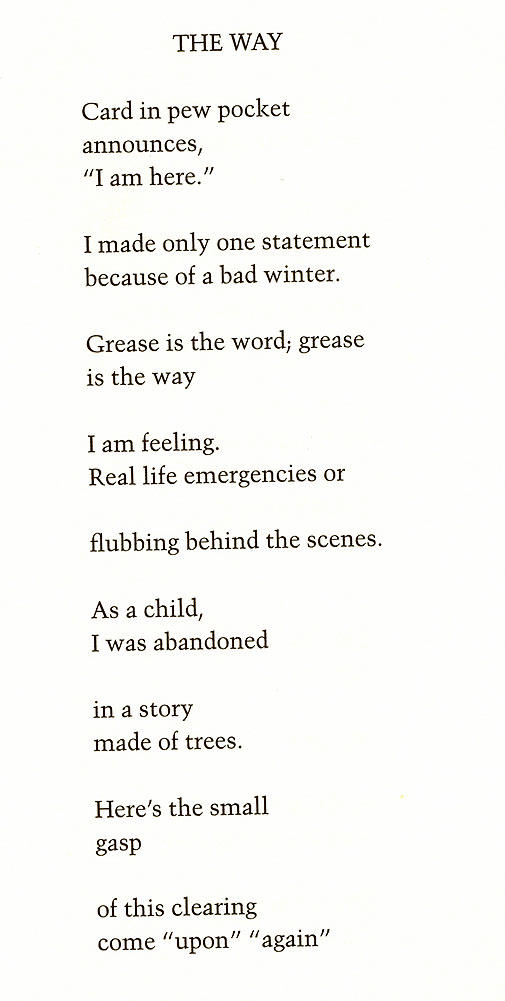
Solution
A solution is found
when creatures
from the last ice age
band together
to survive.
Circumstances spin
like the mobile
above a baby crib.
Follow along
with an endearing
first person,
a penguin.
You won't get far.
You're the thing
that waits
to trap
each passing thought,
the anxious
blank
that God loves.
27 August 2009


22 August 2009
Jack Spicer
[from Jack Spicer's My Vocabulary Did This to Me: Collected Poems, Wesleyan, 2008]
For Harvey
When you break a line nothing
Becomes better.
There is no new (unless you are humming
Old Uncle's Tom's Cabin) there is no new
Measure.
You breathe the same and Rimbaud
Would never even look at you.
Break
Your poem
Like you could cut a grapefruit
Make
It go to sleep for you
And each line (There is no Pacific Ocean) And make each line
Cut itself. Like seaweed thrown
Against the pier.
21 August 2009
Jack Spicer
[from Jack Spicer's My Vocabulary Did This to Me: The Collected Poems of Jack Spicer, ed. Peter Gizzi, Kevin Killian, Wesleyan, 2008]
Dear Lorca,
When I translate one of your poems and I come across words I do not understand, I always guess at their meanings. I am inevitably right. A really perfect poem (no one yet has written one) could be perfectly translated by a person who did not know one word of the language it was written in. A really perfect poem has an infinitely small vocabulary.
It is very difficult. We want to transfer the immediate object, the immediate emotion to the poem -- and yet the immediate always has hundreds of its own words clinging to it, short-lived and tenacious as barnacles. And it is wrong to scrape them off and substitute others. A poet is a time mechanic not an embalmer. The words around the immediate shrivel and decay like flesh around the body. No mummy-sheet of tradition can be used to stop the process. Objects, words must be led across time not preserved against it.
I yell "Shit" down a cliff at an ocean. Even in my lifetime the immediacy of that word will fade. It will be as dead as "Alas." But if I put the real cliff and the real ocean into the poem, the word "Shit" will ride along with them, travel the time-machine until cliffs and oceans disappear.
Most of my friends like words too well. They set them under the blinding light of the poem and try to extract every possible connotation from each of them, every temporary pun, every direct or indirect connection -- as if a word could become an object by mere additino of consequences. Others pick up words from the street, from their bars, from their offices and display them proudly in their poems as if they were shouting, "See what I have collected from the American language. Look at my butterflies, my stamps, my old shoes!" What does one do with all this crap?
Words are what sticks to the real. We use them to push the real, to drag the real into the poem. They are what we hold on with, nothing else. They are as valuable in themselves as rope with nothing to be tied to.
I repeat -- the perfect poem has an infinitely small vocabulary.
Love,
Jack
20 August 2009
Cathy Park Hong
Year of the Pig
8.1
Brother, we were thralled by massif dead pigs floating
downriver we hauled butchered feasted
then squalled for it was rotted meat.
Feeblest of bipeds we were but monks prayed for us,
cured us of our rankled bodies.
Now the new observatory’s been ransacked for its myths,
the telescope shattered to a million bifocals
the furrier uses em now to sew tiny rabbit mitts
w’hayseed beads for forcep babes
of the landlord foe. . . .
-- read the rest of this poem and more poems by Cathy Park Hong and others at Octopus Magazine #12
19 August 2009
Jack Spicer
A Postscript to the Berkeley Renaissance
What have I lost? When shall I start to sing
A loud and idiotic song that makes
The heart rise frightened into poetry
Like birds disturbed?
I was a singer once. I sang that song.
I saw the thousands of bewildered birds
Breaking their cover into poetry
Up from the heart. . . .
-- read the rest of this poem by Jack Spicer @ EPC
18 August 2009
ideas
To restore silence is the role of objects. — Samuel Beckett
Can it be the language now contains more words than there are things? — Clark Coolidge
What mind worthy of the name ever reached a conclusion? — Gustave Flaubert
Indeed the whole visible world is perhaps nothing other than a motivation of man's wish to rest for a moment. — Franz Kafka
The poem may have to mean nothing for a while or reflect in its meaning just the image of meaning. . . . There's something that isn't learned or even known yet. — Bernadette Mayer
Man is a curious body whose center of gravity is not in himself. — Francis Ponge
Thought is made in the mouth. — Tristan Tzara
There is a PREMONITION IN LANGUAGE of the unknown vaster world. — Benjamin Lee Whorf
15 August 2009
Walt Whitman
[from Walt Whitman's Leaves of Grass, 1860]
Calamus 39
Sometimes with one I love, I fill myself with rage, for I fear I effuse unreturned love;
But now I think there is no unreturned love -- the pay is certain, one way or another,
Doubtless I could not have perceived the universe, or written one of my poems, if I had not
freely given myself to comrades, to love.
07 August 2009
e-chapbooks
Visit 2River to sample their e-chapbooks. The newest e-chap is ˆHow the World Was Made by Christien Gholson.
05 August 2009
trying to publish a poetry e-book
Instead of publishing my first full-length poetry book in the traditional way, I decided I would go all-digital, no paper unless a reader decides to print a hard copy. Factors contributing to my decision include my wish for as many people as possible to read my poems, my geek longing to learn how to create an electronic book, my unwillingness to pay contest fees, my unwillingness to wait a year (or forever) for a publisher to select the manuscript and release the book; and my wish not burden the economy with cost and the planet with pollution caused by paper, ink, printing, inventory, and shipping.
When I began to convert my manuscript from Microsoft Word to PDF, webpage, and Kindle formats, I assumed it would be difficult and it might have been had the text been prose and not poetry. The key problems I encountered were inter-line and intra-line spacing, indents, special characters like em dashes and diacritical marks, and the table of contents. Microsoft Word is a horror, but there is not a replacement yet.
Converting to Kindle format was the most difficult because their converter does not give detailed error reports, and their Kindle previewer is not a full function previewer. Hyperlinks, for example, do not work. Nonetheless, I've done it, although I won't know for sure how well I've done it until I submit the book to Amazon and read it on my Kindle.
I will publish a how-to-guide when I'm finished.
26 July 2009
Caroline Bergvall
[from Caroline Bergvall's essay "A Cat in the Throat: On Bilingual Occupants," in Jacket #37, 2009]
In French, one doesn’t just clear one’s throat, one has a cat in the throat. One would need to spit the cat (‘le chat’) out to clear one’s throat. Literally, ‘un crachat’ is a spittle. One could also clear one’s throat and realise that one has spat out a chatte (French slang, pussy). This adds and maintains a crucial libidinal and erotic bond with one’s pussycat. At a profound level, one could certainly argue that this phrase is a reminder that what separates humans from animals, at least since the 18th Century, is articulated language. It is articulated language that keeps the cat from turning into a human. Articulated language that separates the human from the asocial groaning of the ‘noble savage’. Articulated language is all that which becomes possible once the cat, the animal, the pure physiology of sound, has been successfully removed from my throat.
Conversely, it is all that which is threatened with inarticulacy if the throat is not cleared, if the cat still meows. As I become aware that I am trying to speak, my body morphs, my cat appears. Cat is the tone in my speech, its accentedness, its autography. Cat is my hesitations, my speech’s subjective accent, the tone in my speech, the stutter of my silencings, the explicit accentedness of its functionality. So what if I were to decide to talk with a cat in the throat? The question is highly charged. While it leads to libidinal fantasies, it also addresses questions of cultural and linguistic dominance, and attending issues of language policy and language erasure within the culture.
I am reminded that English-speakers do not so much struggle with cats as with frogs. It is a croaking frog that the English will wish to clear. Given the dubious and long-standing historical traffic of culinary jokes and insults between the French (‘frogs’) and the English (‘rosbif’) and bearing in mind the old wars of invasion and occupation between the two countries, one could here speculate that ‘having a frog in the throat’ resonates more with military and political history, and the known influence of French on the development of English vocabulary, than with strictly contemporary matters. However, John Tranter brings contemporaneity to it when he signals to me in a correspondence the wonderful John Ashbery line: ‘I hear the toad crooning’.
25 July 2009
Paul Hoover
[from Paul Hoover's Poems in Spanish, Omnidawn, 2005]
The Presence
We know it and we feel it —
the fierce will of things
to set themselves apart,
isolated by their beauty,
bereft in isolation.
Museum of the Thing:
the living glove, earthen shoe,
a parakeet’s soft feather
that seems to be made of fur —
yellow tuft of sunlight
falling through the air
like nothing but itself,
as water is nothing but water,
grinding and turning as if
there were no passage.
Where does the work get done
that tenders so much beauty
and leaves us in such grief?
Sweetmeat and papaya,
your own face in chrome
with its hint of speed —
all these chaste subjects
love us in their way —
needle & thimble, dog & bone.
Whatever is absent in them,
let is speak its name:
fingerprint, blue smudge,
a typewriter with new keys —
one for infinity and one for sleeping.
Each night the objects come
to watch us in our beds,
above which hang
the dusty family portraints
retreating toward a quaintness
that can only be remembered —
mother in her kingdom
of white gloves and black bibles,
the mouse she trapped in her hand
as it leaped from a cabinet.
And father, poor father,
whose kindness went on forever,
into a clear confusion,
what were those sounds I heard
from the bed beyond the wall?
Which way should I drive now
to find the house we lived in,
vanished including its trees?
Gone the upstairs bedrooms
with their perfect shining floors,
not even a ghost to warm them.
All things come to witness
these absences like objects —
pears so near to ripeness
they melt in the hand
and roads that go only south,
with a sound of tires like rain.
Buy Paul Hoover's book @ SPD or Amazon
22 July 2009
Gerard Manley Hopkins
Inversnaid
This dárksome búrn, hórseback brówn,
His rollrock highroad roaring down,
In coop and in comb the fleece of his foam
Flutes and low to the lake falls home.
A wíndpuff-bónnet of fáwn-fróth
Turns and twindles over the broth
Of a póol so pitchblack, féll-frówning,
It rounds and rounds Despair to drowning.
Degged with dew, dappled with dew
Are the groins of the braes that the brook treads through,
Wiry heathpacks, flitches of fern,
And the beadbonny ash that sits over the burn.
What would the world be, once bereft
Of wet and of wildness? Let them be left,
O let them be left, wildness and wet;
Long live the weeds and the wildnerness yet.
19 July 2009
Hayden Carruth
[from Hayden Carruth's Collected Shorter Poems: 1946-1991, Copper Canyon, 1992]
The Wreck of the Circus Train
Couplings buckled, cracked, collapsed,
And all reared, wheels and steel
Pawing and leaping above the plain,
And fell down totally, a crash
Deep in the rising surf of dust,
As temples into their cellars crash.
Dust flattened across the silence
That follows the end of anything,
Drifted into cracks of wreckage.
But motion remained, a girder
Found gravity and shifted, a wheel
Turned lazily, turning, turning.
And life remained, at work to
Detain spirit: three lions, one
Male with wide masculine mane,
Two female, short, strong, emerged
And looked quickly over the ruin,
Turned and moved toward the hills.
But Hayden Carruth's book @ Amazon
17 July 2009
16 July 2009
Ekleksographia
Read poems by Annie Finch, Sampson Starkweather, Evie Shockley, Tomaž Šalamun, and many more in issue two of Ekleksographia, guest edited by Amy King.
15 July 2009
Kent Johnson on Eliot Weinberger
[from Kent Johnson's "Notes on Notes on Translation," Jacket 36, 2008]
[Eliot Weinberger]
21. To translate is to learn how poetry is written. Nothing else is so successful a teacher, for it carries no baggage of self-expression.
[Kent Johnson]
To translate is also to more deeply learn, and marvel at, how grammar works — in one’s own language and in another. And it is to begin, however tenuously, to learn and marvel (this via J.H. Prynne) at the mysterious space or interval between languages — that shimmering area between repelling poles of grammar, which traces or residues of meaning cannot traverse. An area which is very much at the heart of poetry’s substance, perhaps . . .
11 July 2009
Sara Michas-Martin
[Sara Michas-Martin's poem from Jubilat 16, 2009]
Pareidolia
I didn't notice last time
the hooked branches and fenced-out
sky -- the leaves' flammable
glare. I didn't hear the bells swing
in my sideways glance or see
the creatures with spiked horns
clash in the bark's design.
In the ferns a nervous shadow, a person
stooped to bury
tokens in the ground. A squirrel
splashes the brush and I'm
spooked, a flood-burn
to the exterior. The lady in the briar
jostles the bats in her hair. Up close
they are heavy birds, thunderous
when they snap away.
Through filtered light I see
my lion take shape. I watch her
pace, maybe swagger, no
this time she's lying down.
09 July 2009
Fanny Howe
[from Fanny Howe's The Lives of a Spirit & Glasstown: Where Something Got Broken, Nightboat, 2005]
Crosses and Branches
I shall not be married, I suppose. Berry by berry and nut by nut, the tree will grow bare. Like a bird feeding its fledgling, the visionary clasp will first melt, then chill. And stately raindrops will fall on the long lawns, beyond the portions of the poor, myself hutted and hatted, face up.
The service is over. Will he look at me? No, and I grieve. Mute is my mouth, which can only speak the truth, or nothing. Probably I will be an old maid, asking, What was I created for? My children, after all, have grown and are gone. Still I long for something daily, to discover and to know like numbers. A man was never a thing to love, but an experience to have.
I visited its brink one twilight, it was like a certain old thorn, the kind that looks sharp but crumbles between your thumb and forefinger. My black apron was carrying roses toward a glass door. I was told he could never do with a talkative wife. In company he is quiet. It's a poor harbinger of luck who has no knowledge of happiness. I was not pricked.
I paused behind the monuments, and gazed toward the city lights beyond the rectory. If I seem hard to you, while the stars gather and glitter in my eyes, it's because these indefinite abstractions put a shawl over my hopes. G-d of Heaven, be clement! Not often do people test the divine conflicts and come out prevailing in prayer.
See, I've had a suffering night! The whispering of zephyrs, the carol of crickets. I felt I was imprisoned in a drawer between shrouds and sheets, all folded and cold. If there was bread, butter, pastry, and salt on the shelves of my own pantry, none of it could nourish the breath in me. A terrible dream seized me like a tiger trainer.
I was a little girl being shipped from America. We were seated at a table, the food like ashes on each plate, and he puckered his black eyebrows and smote his chest with the force of Demosthenes. The boat rocked to and fro. The elements were in a ferment: tempests and whirlwinds and mountains of waves on either side. The wind came almost wholly from NNE, and the sails were in rags. Oh Papa, save me and leave!
His smutted face engraved itself in my terror, as he thought I was happy! It was then that the water changed color, and apertures in the clouds gave glimpses of writings. My underminded structure sank into childhood. The boat grew wings and was flying like a twin-engine on a runway of sea.
This little girl sat in her chair, strapped, her face pale with suffering. She smoothed her hair under her beret, and gazed steadily through the porthole into the stormy sea. A silk ribbon hung around her neck, and a gold chain -- both in the repository of her jewel casket at home. She carried a little satin bag with a tassel of silver beads, and was the image of polar winter. He handed her a cookie, this man who was dangerous people.
Like the hollow tree or chill cavern, forsaken, lost, wavering, the little girl's expression. Then she bit, as if with the wild beast and bird, as if hunger and cold were her comrades, the green wilderness her mother, and as if she was chewing a juicy berry, or saccharin root and a nut. It was wonderful then to see the ocean turn into mossy banks, soft as pincushions and the pinions of the plane wobble and fly.
She was alone again, and free -- all this expressing the force behind fragility. I woke and woke again, and went out to walk in the designated area. You can't make a diagonal path across any part of the grass here, but must follow the asphalt. Little wire fencing is looped along the borders there, and no signs are unnecessary. When I look at a wire, or a knife, sunk into the earth, I know that one element accepting another is really saying NO.
Yet because I lived here, and had been instructed, I also sensed that this landscape wanted to represent the Messianic age. How? Each path was designed as if the next, at last, would represent progress; and each step was, paradoxically, drenched in the tangle and nostalgia of the old days. There were a good many rules driven toward field and furrow (don't walk on ice, don't stray and get lost) and none of them together has produced perfection of action in one soul. The pleasure of reliving old flaws may be irresistible.
Now when there's only a very small splash of disarray (a bent red tulip, a snap of thorns across the grass) and the rest around remains in order, you imagine that this disarray was meant to be! So, too, the human being is composed of intentional mess, of necessity, and the will. Misreading, buoys the spirit. I think every event is unpredictable.
Papa's rules are innate to his landscape; they force you to think twice. How can I scale that wall, never? If the watchtower man has his back turned, can I make a dive into the flume, and crumpled up, get shot? And it's only when you lie down defeated and dream that you experience a love that is frosted with hot lightning and colors, shapes and textures so transparent, they are apparitions of perfection.
In dreams you see through solids! It's Papa's way of showing you how to know G-d: with all your parts abandoned, cast down, while your spirit is free to move about.
Buy Fanny Howe's book @ Amazon
02 July 2009
Subscribe to:
Posts (Atom)